Written by

Eric
Author from Zeitro

Share this article

Subscribe to updates

Thank you! Your submission has been received!
Oops! Something went wrong while submitting the form.

I still remember the days when "underwriting" meant sitting at a desk buried under piles of W-2s, bank statements, and tax returns, highlighting guidelines in thick physical binders. If you're a loan officer or a broker in today's market, you know that those days are, thankfully, mostly behind us.

Whether you are an independent broker trying to scale or a lender looking to slash "time-to-close," mortgage underwriting automation has become the engine of our industry. In this guide, I'll break down what this technology actually is, how it's changing the way we work, and which tools are actually worth your time.

What is Mortgage Underwriting Automation?

Mortgage underwriting automation is the use of technology, specifically algorithms and AI, to evaluate a borrower's creditworthiness against specific lending guidelines. While "Manual Underwriting" relies on a human to cross-check every detail of a 1003 application against a handbook, automation does the heavy lifting in seconds.

I like to think of it as a bridge between raw data and a final "yes." In the US, this usually takes the form of an Automated Underwriting System (AUS). It doesn't just calculate numbers. It applies logic to determine if a loan fits the risk profile of an investor. We need this because today's borrowers expect instant answers. If you can't provide a pre-approval in minutes, they'll find a broker who can.

Key Features often include:

  • Data Integration: Automatically pulling credit reports, income verification (VOE/VOI), and asset data.
  • Rule-Based Engines: Instant matching against Fannie Mae, Freddie Mac, or private investor guidelines.
  • Risk Scoring: Analyzing DTI (Debt-to-Income) and LTV (Loan-to-Value) ratios in real-time.
  • Conditional Approval Generation: Creating a "needs list" for the borrower immediately.
  • Fraud Detection: Identifying inconsistencies in social security numbers or employment history.
  • Document Recognition (OCR): "Reading" uploaded PDFs to extract relevant financial data.

Also Read:

Benefits of Automated Mortgage Underwriting

In my experience, the biggest shift hasn't just been speed. It's the peace of mind. Here is why I believe every modern professional needs to embrace these tools:

  • Massive Time Savings: Massive Time Savings: You can save days of processing time per loan file, often 40-60% faster, by removing the manual "stare and compare" work.
  • Reduced Human Error: AI doesn't get tired at 4:00 PM on a Friday. It checks DTI with 85%+ accuracy every single time.
  • Faster Pre-Qualifications: You can deliver results up to 2.5x faster, which is often the difference between winning a deal and losing it.
  • Scalability: You can handle a sudden surge in volume without needing to double your staff.
  • Transparency: Modern tools provide clear citations, showing exactly why a borrower was or wasn't eligible.
  • Improved Conversion: When borrowers get a 5-minute application experience, they are much more likely to hit "submit."

Limitations of Mortgage Underwriting Automation

I'd be lying if I said technology solved everything. We still need humans in the loop for several reasons:

  • Complexity "Edge Cases": If a borrower has five different self-employment income streams and a unique legal situation, a standard AUS might struggle.
  • Data Quality Issues: "Garbage in, garbage out." If the initial data entry is wrong, the automation will confidently give you the wrong answer.
  • The "Human Touch": Automation can't explain a denial to a disappointed first-time homebuyer with empathy.
  • Over-reliance Risk: I've seen junior LOs stop learning the guidelines because they trust the software too much, which can be dangerous during an audit.
  • Regulatory Shifts: AI models must be constantly updated to stay compliant with changing fair lending laws.

How Does Automated Mortgage Underwriting Work?

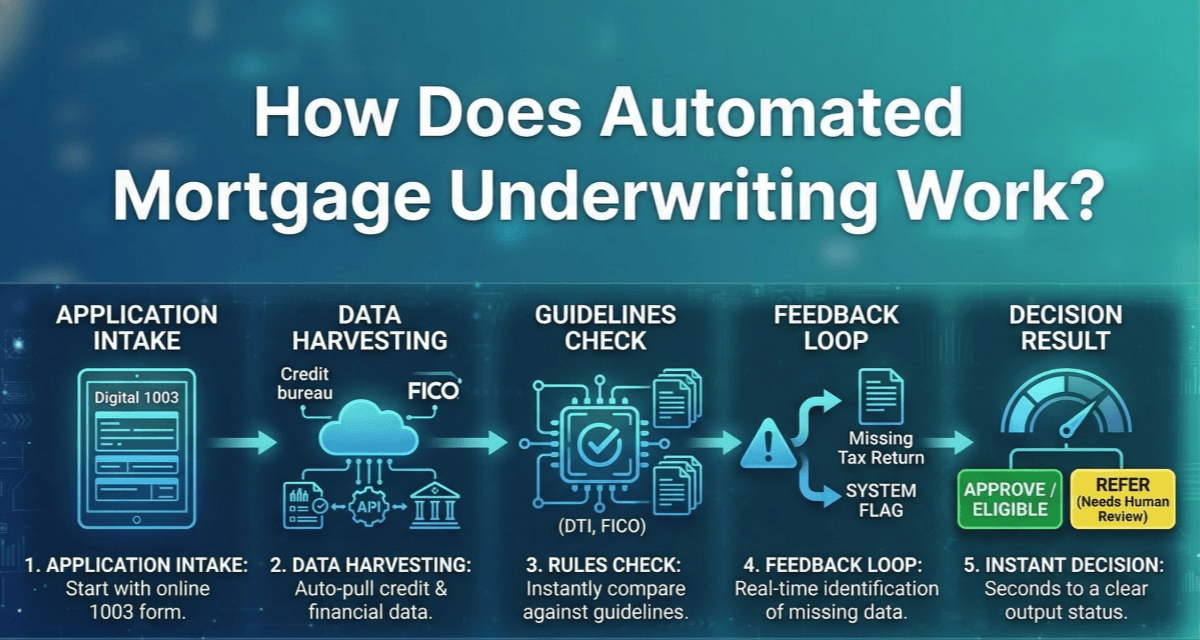
The process is more straightforward than it sounds. Once a borrower starts an application, the "Digital 1003" acts as the intake valve.

  1. Data Harvesting: The system pulls data from credit bureaus and financial institutions via API.
  2. The "Check" Phase: The engine compares this data against thousands of pages of guidelines (e.g., "Is the DTI under 43%? Is the credit score above 620?").
  3. The Feedback Loop: If something is missing, like a missing year of tax returns, the system flags it instantly.
  4. The Decision: Within seconds, the system outputs an "Approve/Eligible" status or a "Refer", which means a human needs to take a closer look.
Tools that Provide Mortgage Underwriting Automation

Fannie Mae's Desktop Underwriter (DU)

Best for: Standard Conventional and High-Balance loans being sold to Fannie Mae.

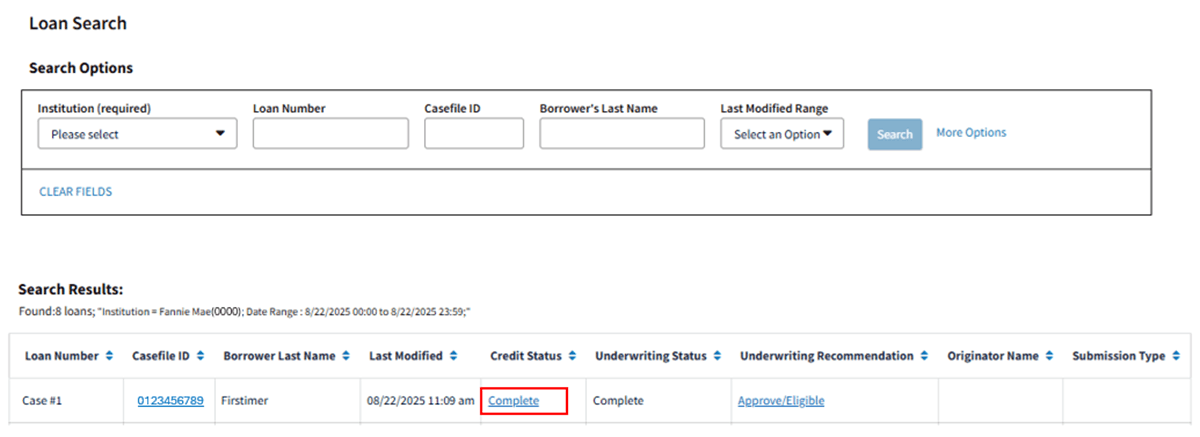
DU is essentially the "North Star" of the American mortgage industry. Since its launch in the 90s, it has set the standard for what a digital approval looks like.
Features:

  • Instant "Approve/Eligible" decisions.
  • Direct integration with almost every Loan Origination System (LOS).
  • Validated income, asset, and employment data through the Day 1 Certainty® program.
  • Extensive support for 2-4 unit properties and manufactured homes.
  • Comprehensive "Findings" report that outlines exactly what documentation is required.

Freddie Mac's Loan Product Advisor (LPA)

Best for: Lenders who want a second opinion or specifically target Freddie Mac's secondary market.

LPA is Freddie Mac's answer to DU. While similar, its risk assessment algorithms can sometimes offer a different result, which is why most brokers I know run both.
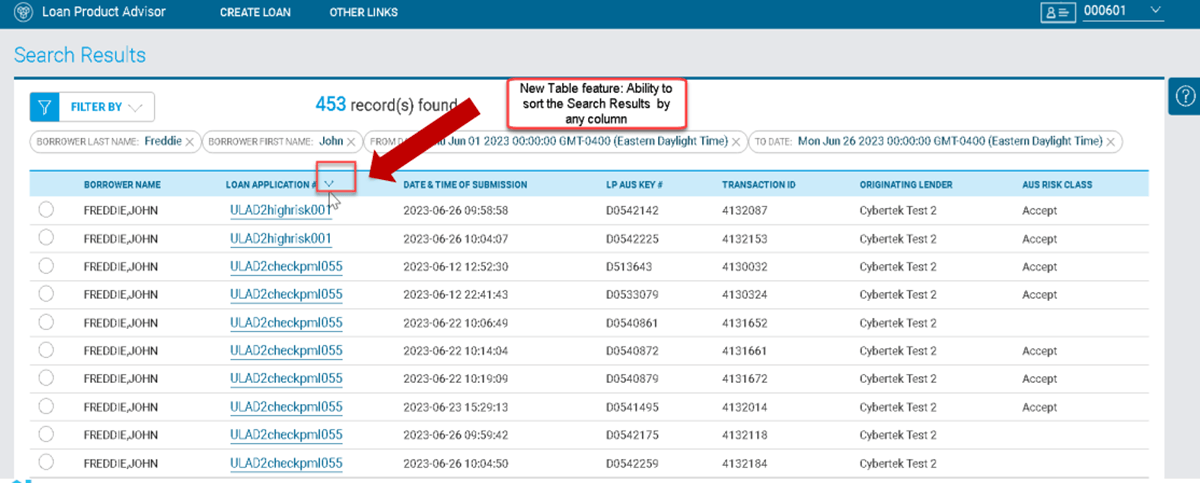
Features:

  • Streamlined "Asset and Income Modeler" (AIM) to reduce documentation.
  • Integrated credit reporting from all three major bureaus.
  • Real-time feedback on loan eligibility.
  • Specific "ChoiceHome" features for affordable housing initiatives.
  • Automated collateral evaluation (ACE) to potentially skip the appraisal.

Zeitro's AI Mortgage SaaS

Best for: Modern brokers and LOs who handle complex Non-QM loans and need a "neutral" AI assistant.

I've found Zeitro to be a game-changer because it's not tied to a specific lender. It's an "AI Agent" that feels like having a senior underwriter sitting right next to you, ready to answer questions about 300+ different guidelines instantly.
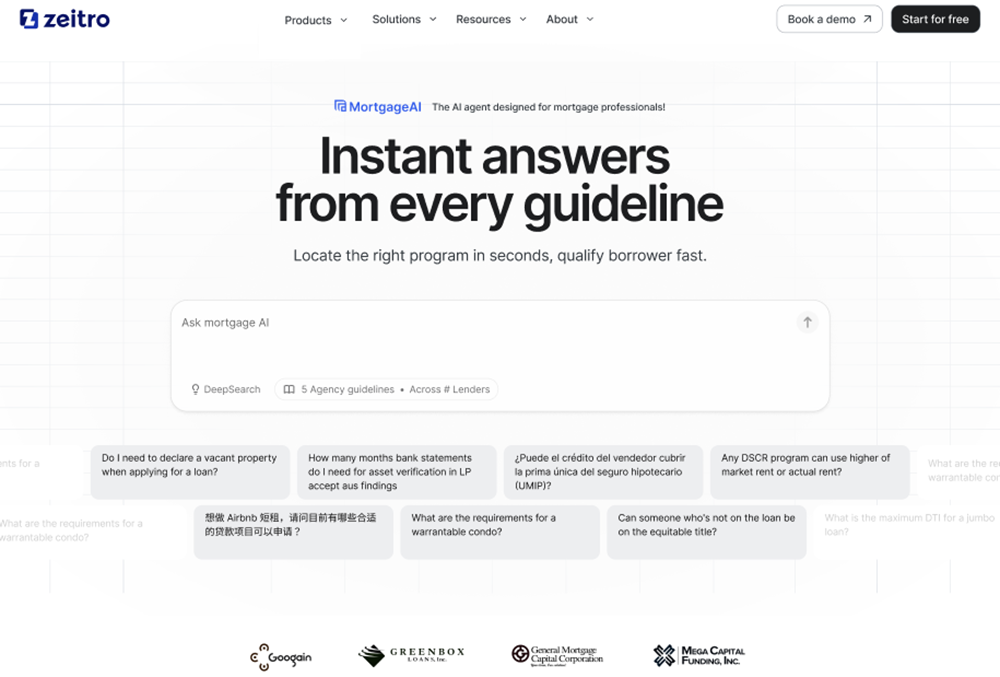
Features:

  • Zeitro Strata AI: A specialized assistant that lets you query complex QM and Non-QM guidelines (DSCR, ITIN, Bank Statement loans) and get answers with citations in seconds.
  • Digital 1003 (POS): A borrower-facing portal that achieves 90%+ completion rates and exports data in FNM 3.4 format.
  • DeepSearch Technology: It cross-checks over 100 investors to find a "home" for your difficult files.
  • AI DTI Calculator: Instantly computes complex ratios using AI-driven tools to ensure pre-qual precision.
  • Personalized Microsites: Tools like Bluerate help LOs build their brand and attract organic leads through SEO-optimized pages.

FAQs about Mortgage Underwriting Automation

Q1. Will automation replace human underwriters?

No. It replaces the "busy work." Humans are still needed for final sign-offs, complex problem-solving, and managing the nuances of high-net-worth or atypical borrowers.

Q2. Can I use these tools for Non-QM or DSCR loans?

Standard systems like DU/LPA aren't built for Non-QM loans. That's where tools like Zeitro Strata AI shine. They are specifically designed to handle the "outside-the-box" guidelines that traditional banks won't touch.

Q3. Is my borrower's data safe?

If you choose the right tools, yes. For example, Zeitro is SOC 2 Type II certified, meaning they meet the "gold standard" for enterprise-grade security and data protection.

Q4. How much does this technology cost?

It varies. While GSE systems have transaction fees, modern SaaS tools like Zeitro offer "freemium" models, with professional tiers as low as $8/month, making it accessible even for one-person shops.

Q5. How accurate is the income calculation?

Top-tier AI tools now reach over 85% accuracy in income calculation, significantly reducing the "back-and-forth" during the processing stage.

Final Word

Moving toward automation isn't just about following a trend. It's about survival in a margin-compressed market. By offloading the repetitive guideline research and data entry to AI, we get to spend more time doing what we actually get paid for: building relationships and closing deals.

My Recommendations:

  • For Conventional Prowess: Master Fannie Mae's DU. It's the industry's backbone for a reason.
  • For Complex & Non-QM Deals: Use Zeitro Strata AI. It's the fastest way to verify eligibility for DSCR, ITIN, or Bank Statement loans without reading 500-page PDFs.
  • For Client Intake: Implement Zeitro's Digital 1003. Your borrowers will love the 5-minute mobile experience, and you'll love the auto-generated FNM 3.4 files.

People Also Read

Keep reading

[2026] Max DTI for Mortgage: Requirements By Loan Types

Blog

5 min read
Arrow icon on dark background
[2026] Max DTI for Mortgage: Requirements By Loan Types
What is the max DTI for mortgage in 2026? A complete guide for loan officers on DTI limits by loan types. Plus, learn how to automate guideline checks with AI.

If you've been originating loans as long as I have, you know that finding the exact maximum Debt-to-Income (DTI) ratio in 2026 feels like hitting a moving target. Every single loan program and investor overlay seems to have its own strict ceiling. It is complex, time-consuming, and honestly, a massive headache for loan officers trying to pre-qualify borrowers quickly.

Instead of digging through hundreds of pages of PDF guidelines, I now use Zeitro Strata AI. It's a free, AI-powered mortgage assistant that instantly cross-checks different lender guidelines to give you exact max DTI requirements in seconds. Let's break down the 2026 standards and how you can stop wasting time on manual lookups.

Why Maximum DTI is Required?

Before we get into the exact numbers, let's take a quick step back. Why are we so bound by these DTI caps? As loan professionals, we know DTI isn't just a random hurdle. It's the ultimate metric for evaluating a borrower's default risk. Here is why the industry enforces maximum limits:

  • Risk Management: Lenders need assurance that borrowers won't drown in debt. A strict ratio protects the lender's portfolio from defaults.
  • Regulatory Compliance: The CFPB's Ability-to-Repay (ATR) rule legally requires us to verify that a borrower has sufficient income to handle their mortgage payments alongside existing obligations.
  • Secondary Market Liquidity: To sell originated mortgages to government-sponsored enterprises like Fannie Mae or Freddie Mac, the files must precisely match their rigid acquisition standards.

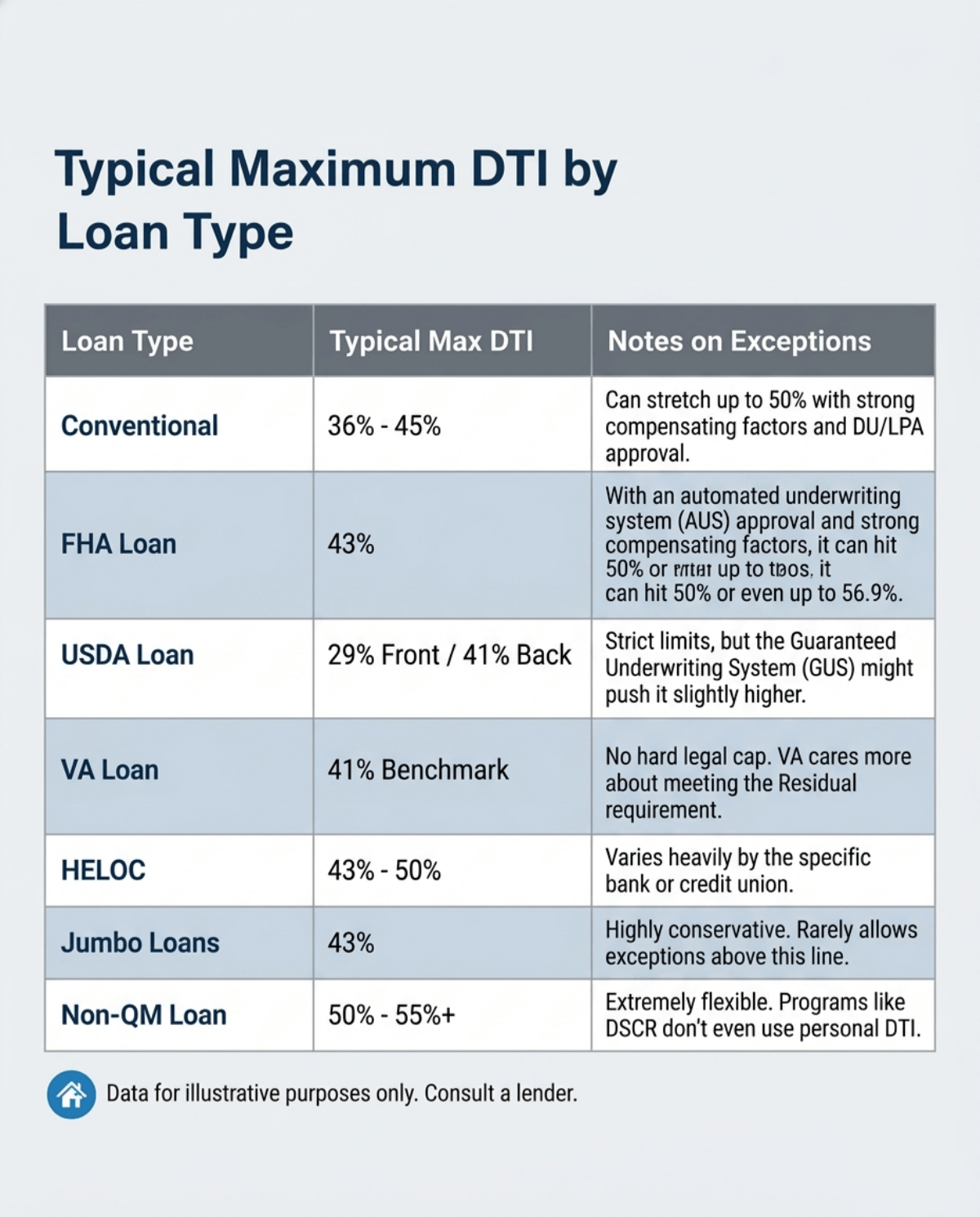
Typical Maximum DTI by Loan Type

Keep in mind, these baseline limits often change depending on specific lender overlays. But based on the 2026 landscape, here is the standard breakdown of maximum DTI by loan type:

  • Conventional: 36% - 45%, can stretch up to 50% with strong compensating factors and DU/LPA approval.
  • FHA Loan: 43%, with an automated underwriting system (AUS) approval and strong compensating factors, it can hit 50% or even up to 56.9%.
  • USDA Loan: 29%, front / 41% Back, Strict limits, but the Guaranteed Underwriting System (GUS) might push it slightly higher.
  • VA Loan: 41%, benchmark, No hard legal cap. VA cares more about meeting the Residual Income requirement.
  • HELOC: 43% - 50%, varies heavily by the specific bank or credit union.
  • Jumbo Loans: 43%, highly conservative. Rarely allows exceptions above this line.
  • Non-QM Loan: 50% - 55%+, extremely flexible. Programs like DSCR don't even use personal DTI.
Typical Maximum DTI by Loan Type

As you can see, the spread is massive. A borrower who gets denied for a Jumbo might easily slide into a Non-QM product if you know where to look.

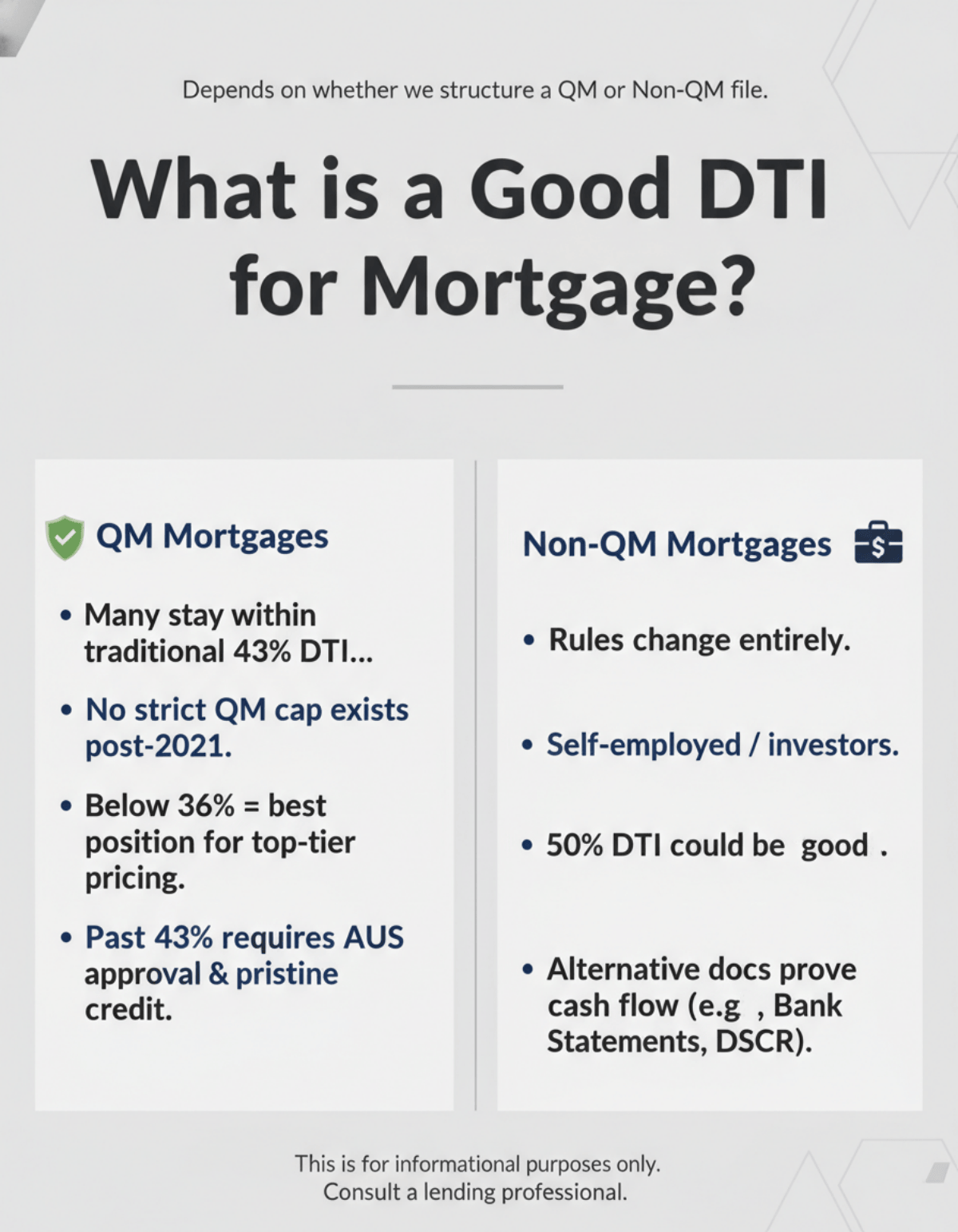
What is a Good DTI for Mortgage?

When a client asks me, "What's a good number?", my answer always depends on whether we are structuring a QM (Qualified Mortgage) or a Non-QM file.

  • QM Mortgages: Many stay within traditional 43% DTI for conservative underwriting, though no strict QM cap exists post-2021 revisions. If your borrower stays at or below 36%, they are in the best position for top-tier pricing and a smooth clear-to-close. Pushing past 43% usually requires automated underwriting approvals and pristine credit.
  • Non-QM Mortgages: The rules change entirely here. For self-employed borrowers or real estate investors using Asset Utilization or Bank Statement programs, a "good" DTI could easily be 50%. Since these products fall outside standard ATR guidelines, lenders rely on alternative documentation to prove cash flow rather than traditional backend ratios.
What is a Good DTI for Mortgage?

What Affects Your DTI Maximum?

You and I both know that a guideline maximum is rarely the final word. Several variables can instantly shift your borrower's DTI ceiling:

  • Compensating Factors: High FICO scores, substantial down payments, and deep cash reserves can convince an underwriter to stretch the limits.
  • Lender Overlays: This is the biggest hurdle. Fannie Mae might technically allow 50%, but your specific wholesale lender's internal policy might hard-stop at 45%.
  • Automated Underwriting Systems (AUS): A DU (Desktop Underwriter) or LPA (Loan Product Advisor) "Approve/Eligible" finding often supersedes manual underwriting guidelines, unlocking higher thresholds automatically.

Understanding these nuances is exactly why quoting a single number to a borrower is risky without checking the exact investor guides first.

Tip: How to Check DTI Guidelines Quickly and Accurately?

Memorizing overlays for dozens of investors is impossible. I used to waste 30 minutes per file digging through PDFs just to verify a Non-QM DTI limit. Now, I use Zeitro Strata AI, the ultimate AI-powered mortgage guideline assistant.

Zeitro Strata AI has deeply indexed over 300+ guidelines from mainstream lenders—including AAA Lending, AD Mortgage, and CMG Financial—covering everything from Conventional to niche Non-QM (DSCR, Bank Statement, ITIN). You just type your scenario in plain English (or Chinese), and its DeepSearch instantly cross-checks 100+ investors. It delivers highly accurate answers in seconds, complete with direct Citations so you can trace the exact source page. Need clarification? Just use the Explain feature.

 Zeitro

Beyond Strata AI, Zeitro offers a complete ecosystem to turbocharge your origination:

  • GrowthHub: Launch a branded personal microsite to showcase your expertise on Bluerate, rank higher on local SEO, and capture leads directly.
  • Digital 1003 (POS): Automate the application process. It pulls borrower data, instantly calculates DTI with AI precision, exports to FNM 3.4, and helps borrowers finish apps in just 5 minutes.
  • Pricing Engine: Get up-to-the-minute rate quotes for both Conventional and Non-QM products, complete with customizable overlay adjustments.

Using this platform realistically saves 7+ hours per loan file and helps me close 30% more loans.

Frequently Asked Questions about MAX DTI

Q1. What is the 33% mortgage rule?

It's a traditional front-end ratio guideline suggesting that your total monthly housing expenses, including principal, interest, taxes, and insurance, should not exceed 33% of your gross monthly income. Sticking to this rule helps ensure borrowers remain comfortable and aren't "house poor."

Q2. What is the 28 DTI rule?

The classic 28/36 rule states that a maximum of 28% of your gross monthly income should go toward housing expenses, while no more than 36% should go toward all total debt obligations combined, including car loans and credit cards.

Q3. What is the maximum DTI for better mortgage?

To secure the most competitive interest rates and ensure a highly favorable underwriting decision, you should aim for a total DTI of 36% or lower. Lenders view this range as low-risk, which translates to better pricing and fewer required compensating factors.

Q4. Is 39 DTI too high?

Not at all. A 39% DTI is considered a very safe and acceptable range in the mortgage industry. It easily falls under the maximum limits for Conventional, FHA, VA, and USDA loans, usually without needing any extra compensating factors.

Q5. Is 35% of income too much for a mortgage?

If 35% is your front-end housing ratio, it is slightly elevated but manageable. However, if 35% represents your back-end total debt ratio, it is actually an excellent, healthy financial position that will easily qualify for almost any loan program.

Q6. Is 42 DTI bad?

No, a 42% DTI is incredibly common. It sits right below the standard 43% cap used by many lenders. You will comfortably qualify for FHA and VA loans, and most Conventional loans will approve it as long as your credit score is decent.

Conclusion

Navigating the 2026 mortgage landscape means accepting that the maximum DTI is never just one single number. It shifts drastically depending on the loan type, your borrower's profile, and the specific investor overlays you're dealing with. As originators, our job is to find the right home for the file, but we shouldn't have to burn hours doing manual guideline research.

If you want to escape the trap of outdated PDFs, I highly recommend checking out Zeitro. Their Explorer plan is completely free and gives you 3 daily Mortgage AI queries, access to the pricing engine, and your own personal website. Stop guessing on DTI limits. Sign up, reclaim your time, and start delivering faster pre-qualifications today.

People Also Read

Best Mortgage Underwriter Certifications: Everything to Know Here

Blog

5 min read
Arrow icon on dark background
Best Mortgage Underwriter Certifications: Everything to Know Here
Master mortgage underwriting with the best certifications. Explore top NAMU & MBA courses to boost your career and salary.

Navigating the mortgage industry can feel like a maze, especially when you're aiming for the role of a mortgage underwriter, the ultimate gatekeeper of loan approvals. In my experience, while many talented professionals enter this field through grit and on-the-job learning, the market has shifted significantly. Today, proving your expertise isn't just an "extra". It's a career-defining move.

Whether you are just starting or looking to climb the ladder at a top-tier lender, choosing the right certification is your most strategic play. In this guide, I'll break down the best mortgage underwriter certifications in the U.S., helping you decide which path will actually move the needle for your salary and professional standing.

Takeaway

  • Not Mandatory, but Essential: Certifications aren't legally required like MLO licenses, but they are often the "tie-breaker" in hiring.
  • NAMU vs. MBA: NAMU offers great specialized niches.MBA is the "Gold Standard" for prestige and long-term executive paths.
  • Tech is the New Skill: Modern underwriters must pair their certification with AI tools like Zeitro to stay competitive.

Do You Have to Have a Certification to Become a Mortgage Underwriter?

One of the most common questions I hear from newcomers is whether they need a license to start. Technically, the answer is no.

Unlike Mortgage Loan Originators (MLOs), who must obtain an NMLS license under the SAFE Act, mortgage underwriters typically work in back‑office roles and are not, as a category, required by federal law to hold an MLO license. However, if an underwriter also performs loan‑originating activities (for example, receiving production‑based compensation), some states or lenders may require an NMLS‑MLO license under local rules.

Don't let that fool you. From what I've seen in current job postings at major banks, resumes without a certification often end up at the bottom of the pile. A certification acts as a "seal of trust," signaling to employers that you understand complex FHA/VA guidelines and federal regulations (like TRID or HMDA) without needing months of expensive hand-holding.

Top Mortgage Underwriter Certifications to Know

The following certifications are issued by the National Association of Mortgage Underwriters (NAMU) and the Mortgage Bankers Association (MBA). These are the most respected bodies in the U.S. mortgage landscape.

Also Read: Best Mortgage Underwriter Training Online: Improve Your Expertise

NAMU-CMU (Certified Mortgage Underwriter)

I often recommend the CMU as the "Foundational Step." It covers the bread and butter of underwriting, including tax return analysis, credit report navigation, and basic appraisal reviews. It's a moderate difficulty level designed to ensure you won't make "rookie mistakes" that lead to buy-backs.

  • Suitable for: Entry-level professionals or Loan Officers looking to transition into underwriting.
  • Requirements: You must complete a series of online training modules and pass the final exam with a score of 75% or higher. There is no strict "years of experience" requirement, making it the perfect entry point for those wanting to prove they have the technical knowledge to handle a file.

NAMU-CMMU (Certified Master Mortgage Underwriter)

CMMU is the "Heavyweight" title within NAMU. It signals that you've moved beyond basic checklists and can handle complex scenarios, such as self-employed borrowers with multiple business entities. In my view, having "Master" in your title significantly increases your leverage during salary negotiations.

  • Suitable for: Senior underwriters and those aiming for management or team lead positions.
  • Requirements: This requires more rigorous testing than the CMU. You'll need to demonstrate a deep understanding of advanced underwriting concepts. This exam is typically recommended for candidates with at least 2–3 years of field experience, as it involves more nuanced case studies.

NAMU-CAMU (Certified Ambassador Mortgage Underwriter)

The CAMU is less about "how to underwrite" and more about "how to lead." It represents the highest level of NAMU recognition. It's perfect for professionals who want to train others or open their own contract underwriting firm.

  • Suitable for: Industry veterans, consultants, and those who want to be recognized as "Thought Leaders."
  • Requirements: This certification requires an extensive background in the industry. It's often the culmination of holding other NAMU certifications and showing a commitment to continuing education and ethical standards in the mortgage space.

NAMU-CFMU (Certified FHA Mortgage Underwriter)

FHA loans have very specific, often rigid guidelines (HUD 4000.1). Being a CFMU means you are an expert in these government nuances. Given that FHA loans are a staple for first‑time homebuyers in the U.S., this certification can make your skill set more resilient during economic downturns.

  • Suitable for: Underwriters working in retail or wholesale lending where government-backed loans are a priority.
  • Requirements: The curriculum focuses exclusively on FHA-specific guidelines, mortgage insurance premiums, and property requirements. You must pass a specialized exam that tests your ability to interpret HUD handbooks accurately.

NAMU-CMRC (Certified Mortgage Regulatory Compliance)

With the CFPB constantly updating rules, compliance is the biggest headache for lenders. I've found that underwriters who understand the legal side, TILA, RESPA, and Fair Lending, are the most valued. The CMRC certificate proves you can keep a lender out of legal trouble.

  • Suitable for: Compliance officers, QC specialists, and senior underwriters.
  • Requirements: You'll study federal regulations and audit procedures. The exam is detail-oriented and requires a high level of precision, reflecting the nature of compliance work itself.

NAMU-CMQCS (Certified Mortgage Quality Control Specialist)

CMQCS focuses on the "Post-Closing" and "Pre-Funding" audit side. It's for people who love finding the "needle in the haystack." If you prefer auditing files for errors rather than live production, this is your niche.

  • Suitable for: Quality Control (QC) staff and Risk Management professionals.
  • Requirements: Candidates must master audit workflows and learn how to report findings to management. It requires passing a focused exam on quality assurance protocols.

NAMU-CCUP (Certified Commercial Underwriting Professional)

Commercial underwriting is a different beast entirely. You're looking at Debt Service Coverage Ratios (DSCR) and rent rolls instead of just W-2s. This CCUP certification is the bridge for residential pros wanting to enter the commercial space.

  • Suitable for: Those looking to leave residential lending for the high-stakes world of Commercial Real Estate (CRE).
  • Requirements: This is a high-difficulty certification. It requires learning complex financial statement analysis and commercial property valuation methods.

MBA-CRU (Certified Residential Underwriter)

If NAMU is the specialist, the MBA is the "Ivy League." The CRU designation is globally recognized and highly prestigious. In my experience, if you want a C-suite or VP role at a national bank like Chase or Wells Fargo, the CRU is your best bet.

  • Suitable for: Career-focused professionals seeking the highest level of industry prestige.
  • Requirements: This is a multi-level program (Levels I, II, and III). It requires a combination of professional experience, points earned through MBA courses, and passing a comprehensive final examination. It is a long-term commitment that usually takes a year or more to complete.

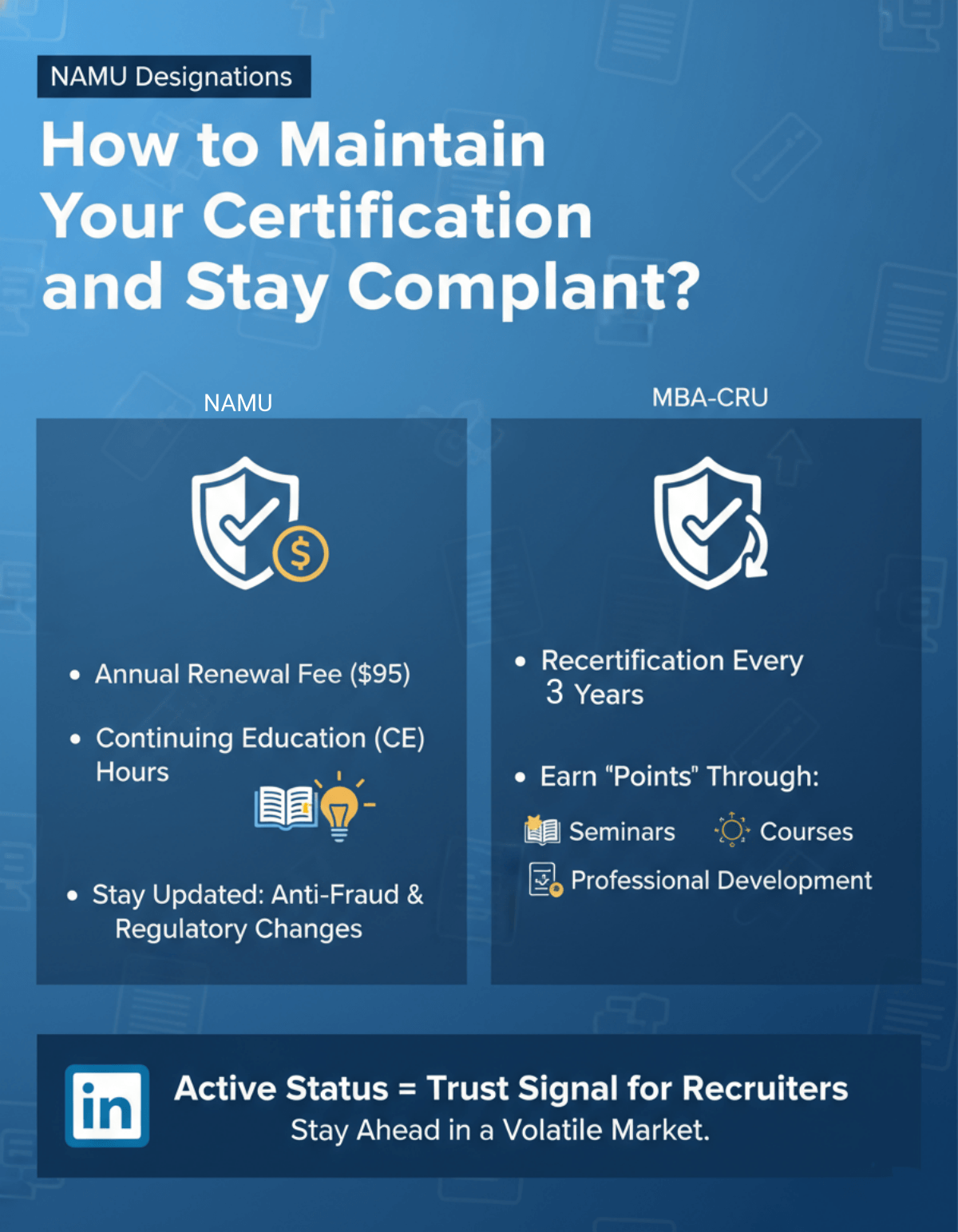
How to Maintain Your Certification and Stay Compliant?

Getting your certificate is a massive milestone, but I always tell my peers: don't let it gather dust. In the mortgage world, guidelines from Fannie Mae, Freddie Mac, and HUD are constantly shifting. To keep your credentials active and respected, you must follow specific maintenance protocols.

  • For NAMU designations, you generally need to pay an annual renewal fee (typically around $95) and may be required to complete several hours of Continuing Education (CE) each year. This ensures you stay updated on the latest anti-fraud measures and regulatory changes.
  • On the other hand, the MBA-CRU requires recertification every three years. You'll need to earn "points" through professional development, attending industry seminars, or taking advanced courses.

In my experience, showing an "Active" status on your LinkedIn or resume is a huge trust signal for recruiters—it proves you aren't just relying on old knowledge, but are actively staying ahead of the curve in a volatile market.

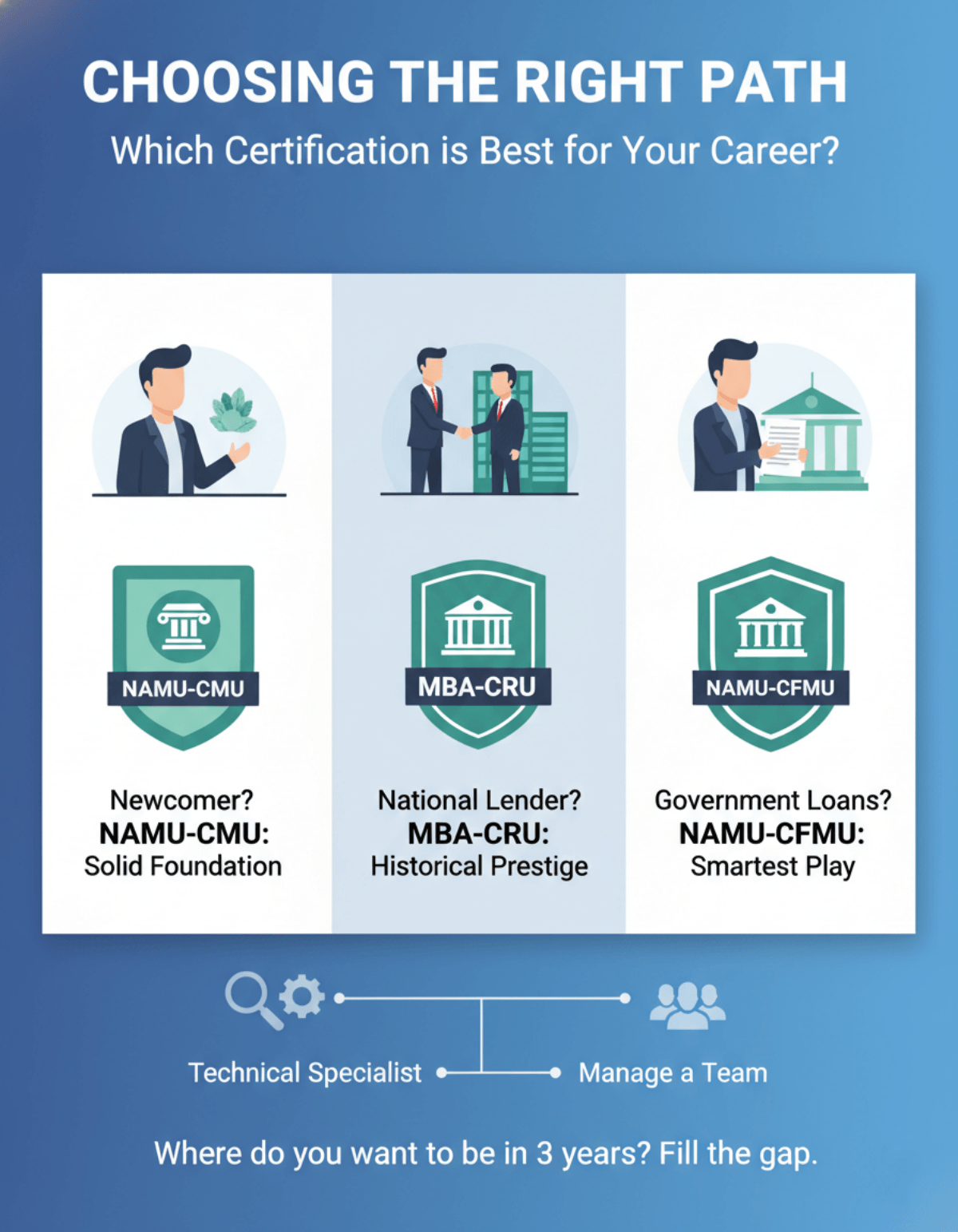
Choosing the Right Path: Which Certification is Best for Your Career?

Picking a certification shouldn't be a guessing game.

  • If you are a newcomer, I suggest starting with the NAMU-CMU to build a solid foundation.
  • If your goal is to work for a major national lender, the MBA-CRU carries the most weight due to its historical prestige.
  • For those who want to carve out a niche in government-backed loans, the NAMU-CFMU is the smartest play.

Think about where you want to be in three years. Do you want to manage a team or be a technical specialist? Pick the credential that fills that specific gap in your resume.

Zeitro: The Missing Piece Beyond Certifications

Even with the best certifications, the sheer volume of data in modern lending is overwhelming. I've realized that professional knowledge is only half the battle. The other half is efficiency. That's where Zeitro comes in. It's an AI-powered SaaS designed specifically for U.S. mortgage professionals to bridge the gap between "knowing the rules" and "applying them fast."

  • Zeitro Strata AI is a lifesaver for verifying complex Non-QM guidelines. Instead of flipping through a 500-page PDF, you can ask specific questions and get sourced answers in seconds. Beyond guidelines,
  • Zeitro's Digital 1003 and Pricing Engine automate the tedious parts of the application and DTI calculations. I've seen it save underwriters 7+ hours per loan file.
  • By using the GrowthHub to showcase your expertise on a branded site, you're not just an underwriter. You're a tech-savvy pro. In today's market, pairing your certification with a tool like Zeitro allows you to close loans 20% faster while maintaining 85%+ accuracy.

FAQs About Best Mortgage Underwriter Certifications

Q1. Can I become an underwriter without a degree?

Yes. While some large banks prefer candidates with a degree in finance, many mortgage lenders place significant weight on hands‑on experience and certifications like the NAMU‑CMU, and may value them as much as or more than a diploma.

Also Read: [NO Experience] How to Become a Mortgage Underwriter?

Q2. What certifications should I get for underwriting?

Start with the NAMU-CMU for general residential work. If you want to specialize, look into the NAMU-CFMU (FHA) or the MBA-CRU for high-level career paths.

Q3. Is NAMU certification worth it?

In my opinion, yes. It is the most accessible and widely recognized specialized training for underwriters, often leading to immediate pay raises or better job offers.

Q4. How long does it take to become a certified underwriter?

For NAMU, you can finish the coursework in a few weeks. The MBA-CRU is more intensive and can take 6–12 months depending on your pace.

Q5. Do mortgage underwriters make good money?

Absolutely. According to recent U.S. labor data, senior underwriters often earn between $65,000 and $85,000, with those holding specialized certifications and using AI tools reaching the higher end of that bracket.

Conclusion

To wrap things up, becoming a top-tier mortgage underwriter in the current U.S. market requires a blend of formal credentials and modern tech skills. While you can technically start without a certification, I've found that those who invest in their education early on see much faster promotions and higher salary ceilings.

However, don't stop at the certificate. The industry is evolving, and manual "PDF-checking" is being replaced by AI. By combining a reputable certification like the MBA-CRU or NAMU-CMU with a powerful AI agent like Zeitro, you position yourself as an indispensable asset to any lender. It's about being more than just a "checker". It's about being a high-efficiency expert who knows how to leverage the best tools to close more loans, faster.

People Also Read

Best Mortgage Underwriter Training Online: Improve Your Expertise

Blog

5 min read
Arrow icon on dark background
Best Mortgage Underwriter Training Online: Improve Your Expertise
Want to boost your salary? Level up your skills with the best mortgage underwriter training online. Compare top programs and check costs here.

I still remember my first few weeks as a junior mortgage underwriter. I was staring at a massive stack of 1003 applications, tax transcripts, and credit reports, absolutely terrified of making a mistake. The mortgage industry moves fast, and the pressure to be perfectly accurate is intense.

If you're feeling overwhelmed by the sheer volume of lending guidelines, you're not alone. To survive and actually thrive on the desk, you need solid training. I've reviewed the best online mortgage underwriter training programs out there right now. We'll find the right fit so you can stop second-guessing your conditions and start clearing files with confidence.

Key Takeaways

  • Guidelines change constantly: Relying on outdated rules leads to loan buybacks. Consistent training keeps you compliant and employed.
  • Certifications give you leverage: Programs from NAMU or MBA Education provide the industry-recognized credentials you need to negotiate a higher salary.
  • You don't always have to pay: If you are a beginner, Fannie Mae's official Learning Center is a fantastic, zero-cost starting line.
  • Tech is the new standard: Modern professionals use tools like Zeitro to cut out the busywork, saving 7+ hours per loan file by automating manual reviews.

Why Do You Need to Take Mortgage Underwriting Training?

You might think you can just learn on the job as a mortgage underwriter, but agency guidelines update constantly. Relying on last year's rules is a fast track to compliance nightmares. Taking a structured training course gives you a massive advantage:

  • Bulletproof compliance: You'll actually understand the why behind federal regulations, ensuring every file meets strict legal standards.
  • Faster risk assessment: Spotting income red flags on a self-employed borrower's tax return becomes second nature, dropping your error rate significantly.
  • Better pay and leverage: Certified underwriters simply make more money. It's the easiest way to jump from a junior role to a senior desk.
  • Less daily stress: When you know the guidelines inside out, you clear conditions faster and sleep much better at night.

Top Mortgage Underwriter Training Programs

Finding a course that actually teaches real-world mortgage underwriting rather than just reading guidelines out loud is tough. I've narrowed down the top options based on curriculum quality, industry respect, and actual usefulness on the desk.

NAMU (National Association of Mortgage Underwriters)

NAMU is pretty much the most recognized name when it comes to industry credentials. They host intensive boot camps covering everything from processing basics to complex manual underwriting. This is really built for professionals who want a heavy-hitting credential on their resume to negotiate a higher salary. Their Official Underwriter Boot Camp includes multiple webinars that dive deep into FHA/VA loans, fraud detection, and tax return analysis.

Completing this program and passing the required proctored exam earns you the Certified Master Mortgage Underwriter (CMMU) designation. Most folks get through the core boot camp in about two to three weeks, but you get a full year of 24/7 access to review the material whenever you're stuck on a weird file. The full boot camp costs roughly $995. Individual classes are cheaper (around $99 to $495). It's pricey, but hiring managers actively look for NAMU certs.

NAMU (National Association of Mortgage Underwriters)

Fannie Mae

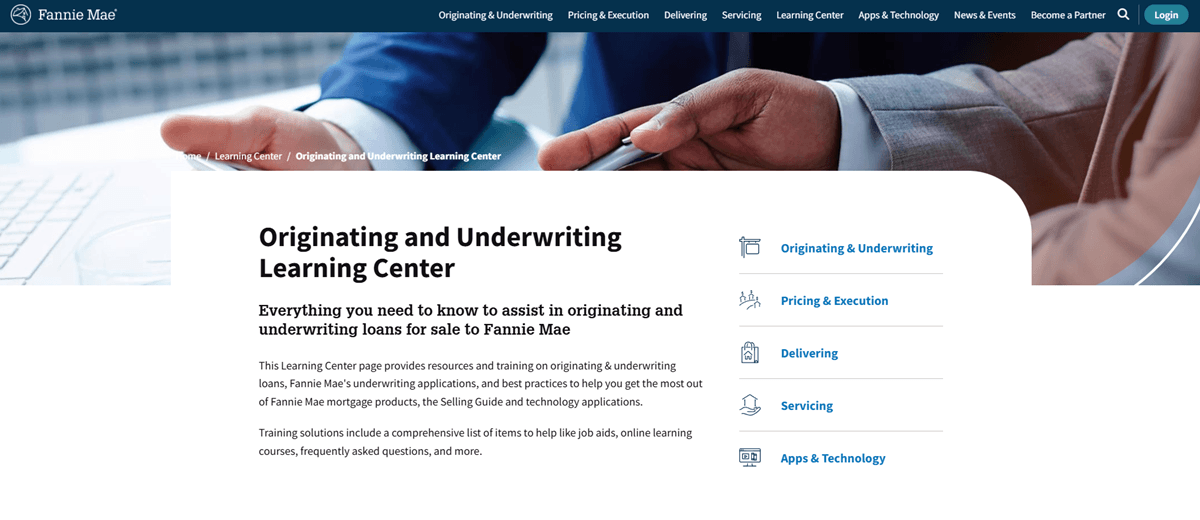
You can't talk about underwriting without going straight to the source. The Fannie Mae Originating and Underwriting Learning Center is their official platform, packed with policy updates and direct guidance on what the secondary market actually buys. Honestly, every single person touching a loan file needs this bookmarked. It's the perfect starting point for rookies who need to learn conventional rules without spending their own money.

You'll find modules on navigating Desktop Underwriter (DU), calculating variable income, and interpreting the Selling Guide. The time commitment is totally up to you. You might spend ten minutes checking a specific job aid or an afternoon working through interactive eLearning modules. Best of all? It's 100% free. Since Fannie dictates the rules for most conventional loans anyway, building your foundation here costs nothing and pays off immediately in your day-to-day file reviews.

Fannie Mae

CampusUnderwriter

Acting as the training arm for NAMP and NAMU, CampusUnderwriter brings a virtual classroom vibe directly to your home office. They focus on instructor-led, recorded webinars taught by people who have actually spent decades on an underwriting desk. If you're a visual learner who zones out reading dry PDF guidelines and prefers a more hands-on, practical teaching approach, this is a great fit.

Their catalog is set up like an a la carte menu. You can pick highly specific workshops, like deep dives into calculating complex Debt-to-Income (DTI) ratios, reviewing tricky appraisals, or figuring out the quirks of USDA rural housing loans. A typical webinar takes a few hours to get through, and you retain access to the video recordings and training manuals for a full year.

Single classes typically run between $99.99 and $395.00. They also offer bundled packages if you need to tackle a few different weak spots in your knowledge base at once.

CampusUnderwriter

MBA Education

The Mortgage Bankers Association (MBA) is a massive player in housing advocacy and education. Their single-family residential loan production courses are known for being academically tough and highly respected by major banks and lenders nationwide. This path is definitely best for ambitious individuals gunning for management roles, corporate underwriting teams, or anyone wanting a broader understanding of the entire loan lifecycle.

They cover everything from basic fraud mitigation up to the prestigious Certified Residential Underwriter (CRU) designation, which requires completing a multi‑level curriculum and passing rigorous proctored exams.

The coursework is incredibly thorough. Depending on the track you choose, a self-study module might take just a few hours, whereas completing a full CRU certification requires weeks of intense studying and passing strict proctored exams. Pricing heavily depends on whether your employer is an MBA member. Members often get basic courses for free, while extensive certificate programs can range from $550 for members to over $1,100 for non-members.

OnCourse Learning

OnCourse Learning is a major provider of regulatory and compliance training across the financial sector. Their mortgage-specific catalog is strictly designed to keep lending staff out of trouble with state and federal regulators. I usually recommend this for underwriters working at regional banks, credit unions, or institutions that require structured, compliance-heavy continuing education to check off corporate HR requirements. Their underwriting modules are very procedural.

They walk you through evaluating a borrower's overall financial health, properly structuring a file for final approval, and spotting the common underwriting mistakes that lead to costly buybacks. These courses are entirely online and self-paced.

A comprehensive underwriting or pre‑licensing track often requires around 20 hours of online study. For a standard 20-hour comprehensive course, expect to pay around b. Costs scale down if your lending institution buys licenses in bulk for the whole underwriting department.

Coursera

You might not expect a tech-focused platform like Coursera to teach mortgage principles, but they partner with universities to offer surprisingly relevant content. Their "Mortgage for Underwriters" material offers a slightly different flavor, mixing traditional credit risk assessment with modern technological trends.

This is an awesome choice for tech-curious beginners or mid-level underwriters who want a fast, affordable look at how the industry is shifting toward predictive analytics and automated workflows. The curriculum is very forward-thinking. Alongside standard modules on credit reports and compliance, you'll learn about machine learning applications in risk analysis and how AI is changing underwriting desks.

It is highly flexible and bite‑sized, with many learners reporting that they complete the video lectures and readings in about 3 hours. It is also extremely budget-friendly. Access depends on your monthly Coursera subscription (usually around $39 to $59 a month), letting you explore this and thousands of other courses without a massive upfront commitment.

Coursera

Comparison of Best Mortgage Underwriter Training

If you are juggling a packed pipeline today and just want the quick breakdown, I've organized this comparison table for you. Picking the right program depends entirely on where you are in your career. Are you trying to land your first junior role, or do you need a heavyweight certification to secure a promotion? Check out the stats below to make a fast decision.

Comparison of Best Mortgage Underwriter Training

My advice? Start reading Fannie Mae's guides for free to build your baseline, then ask your employer to sponsor your NAMU certification once you're established.

Bonus Tip: Leverage AI to Supercharge Your Underwriting Career

After you finish your training, reality hits. The actual day-to-day origination process is exhausting. Staring at hundreds of pages of bank statements and W-2s to manually calculate income will quickly burn you out. This is where leaning into smart tech becomes the best career hack you can use.

Top professionals aren't just working harder. They are using tools like Zeitro to eliminate the grunt work. Zeitro is an AI agent built specifically for US mortgage professionals. It doesn't replace your underwriting judgment. It actually empowers you to clear conditions up to 20% faster and save over 7 hours per loan file. Here is how their setup makes life easier:

  • Zeitro Strata AI: Instead of frantically searching through a 1,000-page PDF manual, you just ask this AI assistant your vague QM or Non-QM guideline questions and get accurate, sourced answers in seconds.
  • GrowthHub: If you're a broker or loan officer, this lets you launch a branded microsite to show off your expertise, display live rates, and capture organic borrower leads online on Bluerate.
  • Digital 1003 (POS): This system automates the tedious application side. It pulls financial data, instantly calculates AI-driven DTI, and exports FNM 3.4 files, letting borrowers pre-qualify in just 5 minutes.
  • Pricing Engine: A super-fast rate quote tool for conventional and Non-QM products, allowing you to apply custom overlay adjustments and price out loans instantly.
Zeitro

FAQs About Mortgage Underwriter Training

Q1. What are the 4 C's of mortgage underwriting?

The 4 C's of mortgage underwriting are Capacity, Capital, Collateral, and Credit. Capacity measures the borrower's ability to repay the debt using their DTI ratio. Capital looks at their down payment and cash reserves. Collateral evaluates the property's value through an appraisal. Finally, Credit reviews their past payment history to predict future reliability.

Q2. How long does it take to become a certified mortgage underwriter?

It generally takes anywhere from a few weeks to several months to get officially certified and become a mortgage underwriter. It depends entirely on your background and the program. A NAMU boot camp, for example, might require two to three weeks of focused study. However, getting truly comfortable making lending decisions on a live desk takes months of practice.

Q3. What certifications should I get for underwriting?

I usually suggest starting with the Certified Master Mortgage Underwriter (CMMU) from NAMU or the MBA's Certified Residential Underwriter (CRU). If you are processing a lot of government loans, obtaining your FHA Direct Endorsement (DE) or VA LAPP/SAR authority is basically mandatory for advancing your career and boosting your salary.

Q4. Are there free mortgage underwriting training?

Yes. The Fannie Mae Originating and Underwriting Learning Center is completely free and provides incredible modules on conventional lending rules. You can also find solid walkthroughs on YouTube. Just keep in mind that while these free options are great for your own knowledge, they won't give you the formal certificates employers look for.

Q5. What is the salary of a mortgage underwriter?

The average US mortgage underwriter salary is around $65,000 to $85,000 a year, according to recent job market data. But that number scales fast. Senior underwriters, or those holding specialized designations like a DE certification, can often reach or exceed $100,000 in high‑volume markets or specialized Non‑QM lending sectors.

Conclusion

Stepping into an underwriting role doesn't have to feel like you're constantly guessing. Investing a little time into a quality online training program is the fastest way to build your technical skills and stop second-guessing your loan decisions. Whether you decide to grab a premium certification from NAMU to boost your resume, or you just spend tonight reading through Fannie Mae's free resources, the most important thing is to start learning.

Pick the course from the table above that fits your current situation. And remember, once you've got those foundational guidelines memorized, don't hesitate to use modern AI tools like Zeitro to cut out the tedious manual data entry. Your pipeline, and your sanity, will thank you!

People Also Read

Try Zeitro today and transform your loan origination workflow!

Get started free