What is Mortgage Eligibility Checker? Best Tool to Verify Guidelines

Blog

What is Mortgage Eligibility Checker? Best Tool to Verify Guidelines

Looking for the best mortgage eligibility checker? Discover how AI tools help loan officers verify guidelines in seconds and save 7+ hours per loan.
March 29, 2026
·
5 min read

Written by

Eric
Author from Zeitro

Share this article

Subscribe to updates

Thank you! Your submission has been received!
Oops! Something went wrong while submitting the form.

As a mortgage professional, I know firsthand how exhausting the loan origination process can be. The constant battle of matching borrower profiles against hundreds of pages of complex investor rules is not just labor-intensive—it's a massive bottleneck. If you are searching for a way to quickly and accurately verify mortgage guidelines, you aren't alone.

We all need a reliable tool to stop wasting hours on manual underwriting. In this guide, I'll explain what a mortgage eligibility checker does and show you why leveraging an AI-powered assistant is the absolute best way to cut your research time down to literal seconds.

What is a Mortgage Eligibility Checker?

A mortgage eligibility checker is a specialized system that cross-references borrower data against vast investor guidelines to determine loan qualification. Historically, this meant flipping through massive PDFs or relying on clunky spreadsheets. Today, the most effective solution is a dedicated AI Agent.

After testing several platforms, my top recommendation for the US market is Zeitro. Founded in 2018 by engineering leaders from Google and Apple, it's an AI-native, completely neutral tech company with no lender affiliations. What gives me real peace of mind is their SOC 2 Type II certification, meaning your borrowers' sensitive data is protected by enterprise-grade security.

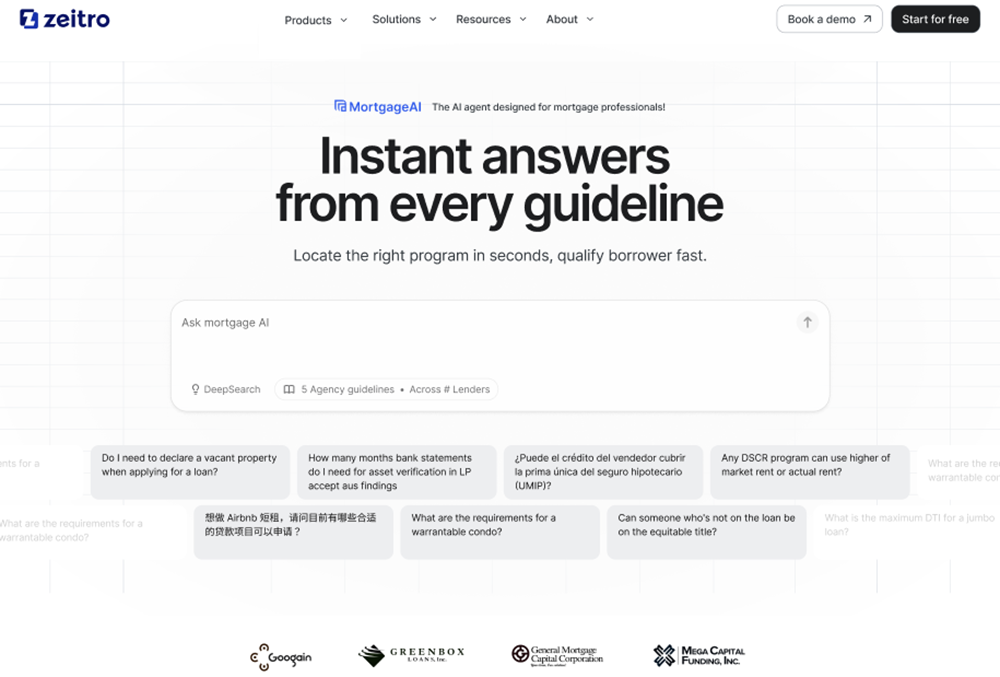
Their standout feature is Zeitro Strata AI, a wildly powerful guideline assistant. It uses a "DeepSearch" function to cross-check over 100 investors and 300+ guidelines simultaneously. Whether you are dealing with standard conventional loans or tricky Non-QM scenarios, like DSCR, ITIN, or Bank Statement loans, it delivers pinpoint accurate answers in seconds. Best of all, it provides exact source citations so you can confidently verify the information yourself. If a rule seems confusing, the "Explain" feature breaks it down further. You can even type your queries in multiple languages, including Chinese.
What is a Mortgage Eligibility Checker?

Beyond just guideline verification, Zeitro offers a complete ecosystem to streamline your entire workflow:

  • GrowthHub: Lets you launch a personalized microsite to boost your SEO, display live rates, and capture organic leads.
  • Digital 1003 (POS): Automates the borrower application, calculates DTI instantly with AI, and exports seamlessly in FNM 3.4 format.
  • Pricing Engine: A real-time rate quote tool for both conventional and Non-QM products to help you offer competitive pricing on the spot.

Who is a Mortgage Eligibility Checker for?

In today's highly competitive housing market, the professional who delivers accurate pre-qualifications the fastest usually wins the deal. A robust eligibility checker is practically mandatory for anyone involved in loan origination.

Loan Officers & Brokers: If you interact directly with borrowers, this tool is a total game-changer. By automating the heavy lifting, you can deliver pre-qualifications 2.5 times faster and save over 7 hours per loan file. This frees you up to focus on relationship-building and bringing in new business.

Wholesalers & Lenders: For teams managing high volumes or complex lending criteria, eliminating 100% of manual guideline research is crucial. Using an AI system ensures an 85%+ income calculation accuracy, allowing your team to close loans up to 20% faster and ultimately increase your total closed loans by 30%.

Who is a Mortgage Eligibility Checker for?

Also Read:

How to Use a Mortgage Eligibility Checker?

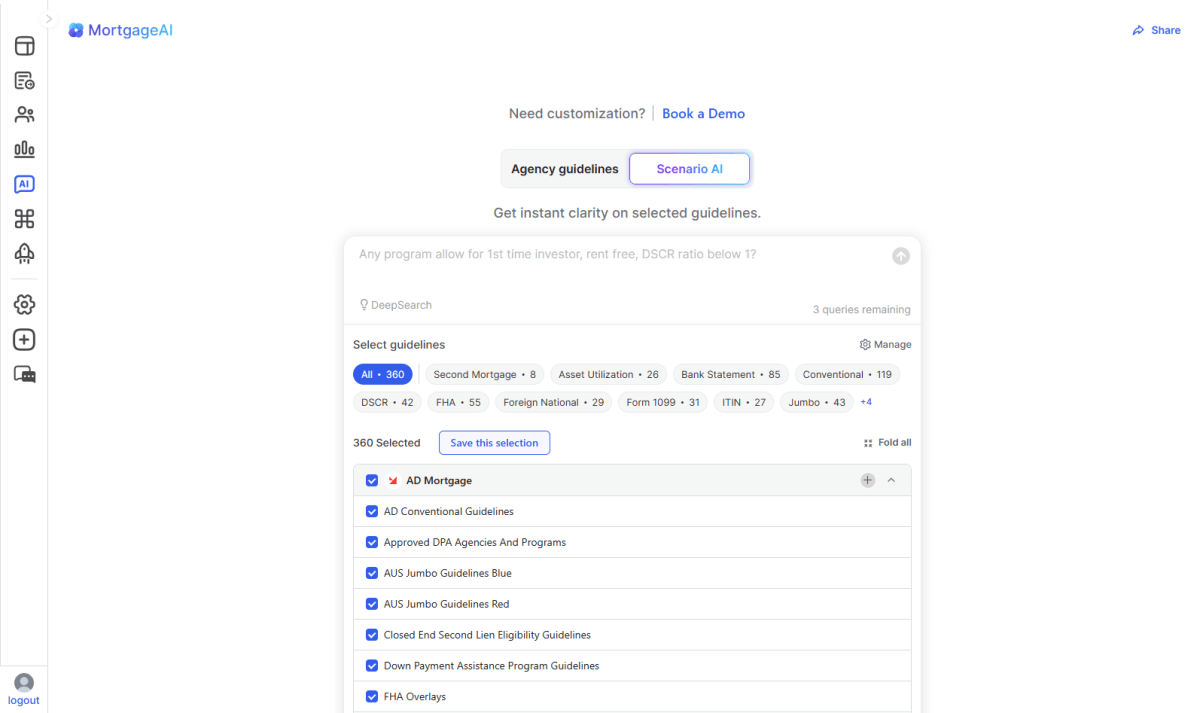
Ditching the old method of manually hitting "CTRL+F" through endless PDFs is incredibly liberating. To show you how simple it is, here is how I use Zeitro Strata AI to check mortgage eligibility in my own daily workflow:

STEP 1. Input Your Scenario: Simply type your question into the chat interface. You can ask broad "what is" questions or highly specific eligibility queries. It even natively supports both English and Chinese inputs.

STEP 2. Customize Your Scope: Apply custom tags like DSCR, ITIN, loan-type, or specific investor names. This instantly narrows the DeepSearch to the exact programs you actually care about.

STEP 3. Get Instant, Sourced Answers: Within seconds, the AI provides a precise answer. I always click the provided citation link to double-check the source for 100% accuracy. If a specific caveat is unclear, I just use the "Explain" function for a deeper breakdown.

STEP 4. Share & Proceed: Once verified, you can easily share the results via a link or email to keep your clients and real estate partners perfectly in the loop.
How to Use a Mortgage Eligibility Checker?

FAQs About a Mortgage Eligibility Checker

Can an AI eligibility checker handle Non-QM loans?

Absolutely. In my experience, this is where a tool like Zeitro Strata AI truly shines. It continuously updates over 300 guidelines from major US lenders like AAA Lending, AD Mortgage, and AmWest, with deep support for complex Non-QM products like Profit and Loss, Foreign National, and DSCR loans.

Also Read: Non-QM Loan Guidelines: How to Check and Verify with AI Accuracy

How accurate are the AI-generated guideline answers?

They are highly accurate because the AI doesn't just guess or hallucinate. It actively cross-checks the most up-to-date guidelines and provides exact citations. You can always trace the answer back to the original source document, which virtually eliminates human error.

How much does a mortgage eligibility checker cost?

Pricing is surprisingly accessible. Zeitro offers a Freemium model. Their popular Explorer plan is completely free, giving you 3  queries per day, a personal website, and 10 lifetime FNM 1003 exports. For power users, it's just $8/month per user or $35/month per company.

Is my borrowers' data secure?

Yes. Security is a non-negotiable top priority in our industry. Zeitro is SOC 2 Type II certified. This means they maintain strict, enterprise-grade operational controls, ensuring all your sensitive customer data is fully protected from start to finish.

Final Word

Navigating the complexities of the US mortgage market shouldn't mean drowning in endless paperwork. A reliable mortgage eligibility checker is no longer just a luxury. It's an absolute necessity for modern loan professionals who want to scale their business. By adopting an AI Agent like Zeitro Strata AI, you can drastically improve your client satisfaction, speed up the lending process, and see a real boost in your overall ROI.

If you are tired of wasting hours on manual guideline research and want to close loans faster, it is time to make a change. I highly recommend taking advantage of Zeitro's Free Explorer Plan. You get three free queries every single day. So go ahead, test a complex scenario, and experience the magic of instant, accurate guideline verification for yourself.

Keep reading

What is LTV (Loan-to-Value)? Meaning, Purpose & Thresholds

Blog

5 min read
Arrow icon on dark background
What is LTV (Loan-to-Value)? Meaning, Purpose & Thresholds
Discover what Loan-to-Value (LTV) means for your mortgage. Learn how this crucial metric impacts your loan approval, interest rates, and avoid paying costly PMI.

When I sit down with first-time homebuyers, they're usually overwhelmed by the alphabet soup of real estate terms. APR, DTI, PMI. It's exhausting. But there is one acronym you absolutely must understand before applying for a mortgage: LTV, or Loan-to-Value ratio.

Why? Because this single number dictates almost everything about your loan. From getting approved in the first place to the interest rate you'll pay every month, lenders use your LTV to figure out how risky your loan is. If you've been confused about what this metric actually means for your wallet, you're in the right place. Let's break it down together.

Key Takeaways

  • Definition: LTV measures your mortgage amount against the property's value.
  • The 80% Rule: An LTV of 80% or lower is generally considered the "golden standard" because it usually allows borrowers to avoid paying Private Mortgage Insurance (PMI).
  • Risk Factor: The higher your ratio, the riskier you appear to lenders, which can lead to higher interest rates.
  • It Changes: Your ratio typically decreases over time as you pay down your loan principal. It can also decrease if your home's value rises, though prices may also fall or stay flat.

LTV Meaning: What is Loan-to-Value in Mortgage?

The Loan-to-Value ratio is exactly what it sounds like: a percentage comparing the size of your loan to the actual value of the home you want to buy. I always tell my clients to think of it as a risk-assessment tool for the bank.

When a lender hands over hundreds of thousands of dollars, they need to know their investment is safe. If you put very little money down, your LTV is high. That means the bank is taking on most of the financial risk. If the housing market crashes and you stop making payments, they might not be able to sell the house for enough to cover what they lent you. Conversely, a lower ratio proves you have serious skin in the game, making the lender feel much more secure about giving you the funds.

LTV Meaning: What is Loan-to-Value in Mortgage?

Why Does LTV Matter?

You might be wondering why this one little percentage carries so much weight. Simply put, your Loan-to-Value ratio directly impacts your wallet.

  • First, it affects loan approval. Most loan programs have a maximum LTV limit. If your ratio exceeds that threshold, lenders may either decline your application or require stronger compensating factors such as higher credit scores, larger reserves, or additional fees.
  • Second, and perhaps most importantly, it dictates whether you'll pay Private Mortgage Insurance (PMI). If your LTV is strictly above 80% on a conventional loan, lenders force you to pay for PMI to protect them in case you default. This can easily add hundreds of dollars to your monthly payment.
  • Finally, it heavily influences your interest rates. Lenders reserve their absolute best rates for borrowers with lower ratios. The smaller the bank's risk, the cheaper it is for you to borrow money.

How to Calculate LTV Ratio?

Figuring out your number is incredibly straightforward. You just divide your total loan amount by the property's value, then multiply by 100 to get a percentage.

The formula looks like this: LTV Ratio = (Loan Amount / Appraised Property Value) × 100

Here is a massive insider tip that most amateur articles miss: Lenders don't just use the price you agreed to pay the seller. They strictly use the lesser of the purchase price or the appraised value.

How to Calculate LTV Ratio?

Let's say you agree to buy a house for $400,000, but the appraiser says it's only worth $380,000. The bank is going to use that $380,000 figure as the denominator in their math. This is exactly why a low appraisal can completely derail a home purchase. It spikes your LTV unexpectedly.

Example of LTV Ratio

Let's look at a realistic scenario so you can see how the math plays out in the real world.

Imagine you finally found the perfect house, and the accepted purchase price is $500,000. Thankfully, the home officially appraises for that exact same amount.

You've been saving up diligently and decide to put down $100,000, which is 20% of the purchase price. This means you need to borrow the remaining $400,000 from the bank.

Now, let's plug those numbers into our formula:

  • Divide the loan amount ($400,000) by the property value ($500,000).
  • $400,000 ÷ $500,000 = 0.80.
  • Multiply by 100 to get the percentage.

Your LTV ratio is 80%. Because you hit that magic threshold, you'll secure a great interest rate and dodge monthly mortgage insurance entirely.

Common LTV Thresholds

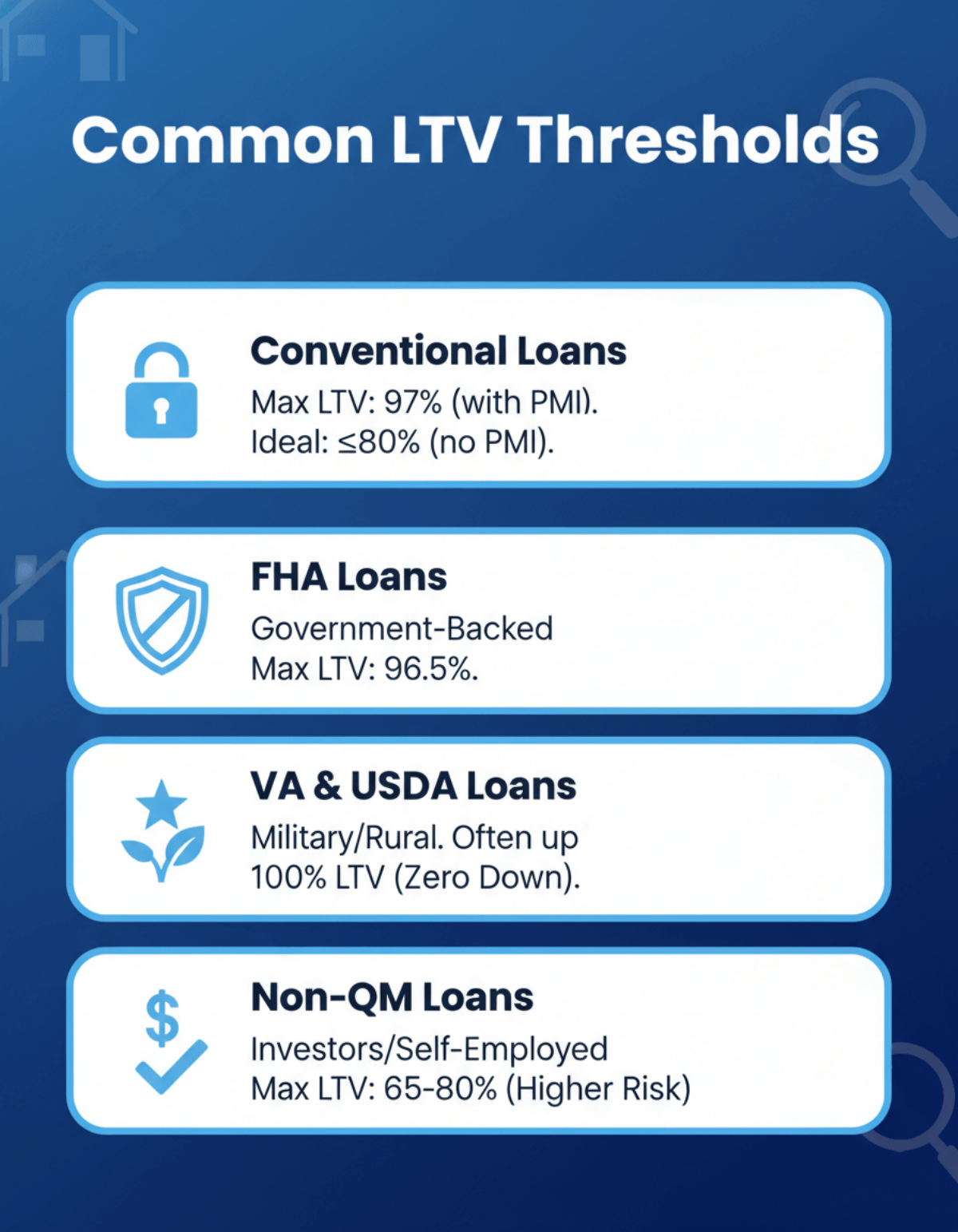
Every mortgage program sets its own boundaries. As a loan advisor, I look at these maximums daily. If you are shopping around for a mortgage right now, here are the standard caps you'll run into:

  • Conventional Loans: The maximum LTV is generally 97% (a 3% down payment), but borrowers at that level almost always pay PMI. The ideal target is 80% or below, as this typically eliminates the need for mortgage insurance.
  • FHA Loans: Backed by the government, these are great for first-time buyers and allow a maximum of 96.5% LTV.
  • VA and USDA Loans: These specialized government programs are incredibly generous. If you qualify (based on military service or location in a designated rural area), they often allow up to 100% LTV, which typically means you can put down zero.
  • Non‑QM Loans (Non‑Qualified Mortgages): These are alternative loans for real estate investors or self‑employed borrowers. Because they are inherently riskier, lenders typically cap LTV much lower than traditional loans, often in the range of about 65% to 80%, depending on the specific program and your credit profile.
Common LTV Thresholds

Tips to Lower Your LTV

Whether you're buying a new place or refinancing your current one, lowering this ratio is always a smart move. Here are my top strategies to drive that number down:

  • Save a larger down payment: When buying, the easiest fix is bringing more cash to closing. Every extra dollar lowers your loan amount.
  • Buy a less expensive home: If you keep your down payment savings the same but target cheaper properties, your percentage drops naturally.
  • Wait for home equity to build: If refinancing, patience is key. As your local housing market appreciates, your home's value goes up, lowering your ratio without you doing a thing.
  • Challenge a low appraisal: If your refinance is blocked by a bad appraisal, you can sometimes submit a Reconsideration of Value (ROV) with better comparable sales to boost the formal value.

LTV vs. CLTV: What's the Difference?

It is very common to mix up LTV with CLTV (Combined Loan-to-Value).

Your standard LTV only looks at your primary (first) mortgage. But what if you take out a Home Equity Line of Credit (HELOC) or a second mortgage to remodel your kitchen?

That's where CLTV comes in. It combines all the loans tied to your house. If you have a $300k main mortgage and a $50k HELOC on a $500k house, your LTV is 60%, but your CLTV is 70%. Lenders check CLTV to ensure you aren't over-borrowing against your home's total equity.

FAQs About LTV in Real Estate

Q1. What does 80% LTV mean?

It means you are borrowing 80% of the home's value and paying 20% upfront. This is considered the "golden standard" in the real estate industry because it allows you to qualify for a conventional loan without having to pay for Private Mortgage Insurance (PMI).

Q2. What is a good LTV%?

Generally, 80% or lower is considered an excellent LTV. Keeping your ratio at or below this level minimizes the lender's risk. As a result, you'll be rewarded with the most competitive interest rates and lower overall borrowing costs.

Q3. Is a 60% or 70% LTV good?

Yes, a 60% or 70% LTV is incredibly strong. It shows lenders you have a huge amount of equity. You'll breeze through the underwriting and approval process, secure the absolute lowest interest rates available, and easily avoid mortgage insurance requirements.

Q4. Is a 95% LTV bad?

No, 95% isn't "bad." In fact, it's very common for first‑time buyers using conventional or FHA loans. However, the tradeoff for making a small 5% down payment is that you borrow more, which typically leads to higher monthly mortgage payments and usually requires you to pay for PMI.

Q5. Can the LTV ratio affect your mortgage interest rate?

Yes, absolutely. Mortgage lenders price their loans based on risk. A lower ratio generally reduces the perceived risk to the lender, which often results in more competitive interest rates and lower overall borrowing costs.

Final Word

To wrap things up, your Loan-to-Value ratio isn't just a piece of banker jargon. I's a fundamental metric that literally shapes your homebuying journey. Understanding how it works can legitimately save you thousands of dollars over the life of your loan by helping you avoid mortgage insurance and snag a better interest rate.

Before you start falling in love with houses on Zillow, I highly recommend running your own numbers. Play around with a free online mortgage calculator to see how different down payments affect your ratio. Better yet, reach out to an experienced, licensed loan officer. They can look at your unique financial profile, evaluate your current LTV, and help you structure a loan that actually fits your long-term housing goals.

People Also Read

[2026 Guide] How to Calculate DTI Ratio for Mortgage?

Blog

5 min read
Arrow icon on dark background
[2026 Guide] How to Calculate DTI Ratio for Mortgage?
Ready to buy a house? Find out how to calculate your DTI ratio for a mortgage. Use our simple formula and examples to check if you meet the 43% lender limit today.

Are you losing sleep worrying that your home loan application might be rejected? Many homebuyers stress over their credit scores but completely ignore another critical number. When you sit across from a loan officer, they aren't looking at your promises to pay. They are staring right at your financial data. If you want to take control, you must know how to calculate the DTI ratio for mortgage applications before you even submit your paperwork.

In this guide, I will walk you through exactly what this metric is. We will explore the exact formula, how an online calculator can help, and precisely which debts to include or exclude so you can confidently secure your dream home.

What is the Mortgage DTI Ratio?

Your Debt-to-Income (DTI) ratio is simply the percentage of your gross monthly income that goes toward paying your monthly debts. When evaluating your profile, lenders look at two distinct metrics. The Front-End Ratio (housing ratio) covers only your expected mortgage-related expenses like principal, interest, taxes, and insurance (PITI). However, lenders rely far more heavily on your Back-End Ratio, which encompasses all your recurring debt obligations.

Here is how lenders generally grade your back-end DTI:

  • < 20%: Considered excellent/low debt. You are in a remarkably safe financial position.
  • 36% or less: Ideal for most lenders and highly competitive for conventional loans.
  • 43%: Generally the maximum limit for a standard Qualified Mortgage (QM).
  • 50%: Lenders view this as high-risk, though government-backed programs like FHA or VA might still approve you if you have strong compensating factors like excellent credit or significant cash reserves.
What is the Mortgage DTI Ratio?

What is Included and Excluded in the DTI Ratio?

Calculating your DTI isn't just about adding up every dollar you spend each month. Mortgage lenders use highly specific, standardized guidelines to determine your financial health. They strictly define what counts as a verifiable income source, which liabilities are considered true debts, and which daily living expenses are completely ignored. Let's break down exactly what goes into these crucial calculations.

Income to Include in DTI Calculation

The biggest mistake I see homebuyers make is using their take-home pay for this calculation. Your DTI is always based on your Gross Monthly Income—the total amount you earn before taxes, health insurance, or retirement contributions are deducted.

So, what exactly can you count? You should include your standard base salary or hourly wages. Additionally, you can add overtime pay, consistent bonuses, child support, alimony, and rental income. If you have a side hustle or are self-employed, that money absolutely counts too.

However, there is a catch: mortgage lenders require absolute proof of stability. To use non-fixed earnings like freelance gigs, commissions, or annual bonuses, you almost always need to provide at least two years of official tax returns to prove to the underwriter that this income is reliable.

Debts to Include in DTI Calculation

When tallying up your liabilities, you only need to look at the recurring debts that typically appear on your credit report. First and foremost, this includes your projected new housing payment, meaning your future mortgage principal, interest, property taxes, and homeowners insurance (PITI).

You must also add up your current auto loans, student loans, personal loans, and any legally binding child support or alimony payments you owe. Now, pay close attention to this next part, as it trips up almost everyone: for credit cards, you only include the minimum monthly payment, not your total outstanding balance. For example, if you owe $5,000 on a Visa card but your statement says the minimum payment due is $75, you only add $75 to your monthly debt column.

Debts to Exclude from DTI Calculation

You can breathe a sigh of relief here: your everyday survival costs and lifestyle expenses do not impact your DTI ratio. Lenders exclude these because they are variable living expenses, not fixed borrowed liabilities, and they do not show up on your consumer credit report.

Therefore, you should completely exclude your monthly groceries, dining out, and entertainment budgets. Furthermore, do not include utility bills like water, gas, electricity, or trash collection. You can also leave out your health insurance premiums, auto insurance, gym memberships, and any streaming services or cell phone plans that do not have a hard financial contract binding you to a debt. While these everyday expenses absolutely matter for your personal household budgeting, the mortgage underwriting system ignores them entirely.

Method 1. Use Formula to Calculate DTI On Your Own

If you want to truly understand your financial standing, doing the math yourself is the best approach. It is remarkably straightforward once you have your documents gathered. Here is the exact formula that underwriters use:

DTI Ratio = (Total Monthly Debt Payments ÷ Gross Monthly Income) × 100

Here is my foolproof, step-by-step guide to running your own numbers:

Step 1: Add up your monthly debt payments.

Sit down with your latest credit report and loan statements. Tally up your car payments, student loans, minimum credit card dues, and the estimated PITI for the house you want to buy. Do not include your current rent if you are replacing it with this new mortgage.

Step 2: Determine your gross monthly income.

Look at your pay stubs to find your pre-tax earnings. If you are salaried at $72,000 a year, simply divide that by 12 to get $6,000 a month. Remember to add any documented, allowable side income.

Step 3: Divide debts by income and multiply by 100.

Take your total debt from Step 1 and divide it by your gross income from Step 2. You will get a decimal. Multiply that decimal by 100, and you now have your exact debt-to-income percentage.

Use Formula to Calculate DTI On Your Own

Method 2. Use an Online DTI Ratio Calculator

If you prefer a faster route, the internet is packed with free online DTI calculators. Reputable financial websites, such as Wells Fargo and Bankrate, offer intuitive tools where you simply plug in two primary numbers: your total monthly income and your total monthly debts. Within seconds, the tool spits out your exact ratio.

However, I must warn you about a major drawback: these calculators suffer from the "garbage in, garbage out" rule. Since the tool blindly trusts whatever numbers you type in, it is incredibly easy to get an inaccurate result. If you forget to manually add your estimated property taxes, homeowners association (HOA) fees, or student loans into the "total debt" box, the calculator will give you a falsely optimistic percentage. Ultimately, online calculators are fantastic for a quick estimate, but they should never replace a thorough, manual review.

Online DTI Ratio Calculator

Debt-to-Income Calculation Example

To show you exactly how this plays out in the real world, let's look at a prospective homebuyer named Sarah.

Sarah earns an annual salary of $72,000, which makes her Gross Monthly Income $6,000.Now, let's look at her credit report to find her Monthly Debts:

  • Car loan payment: $300
  • Student loan payment: $200
  • Credit card minimum payment: $100 (Even though her total balance is $4,000, we only use the minimum due).
  • Estimated new mortgage (PITI): $1,800

Total Monthly Debt = $2,400

Using our formula: $2,400 ÷ $6,000 = 0.40.When we multiply 0.40 by 100, we find that Sarah's DTI ratio is 40%.Because her ratio sits comfortably below the 43% Qualified Mortgage threshold, Sarah is in a very strong position to get her home loan approved by most traditional lenders.

FAQs About Mortgage DTI Calculation

Q1. Does DTI use gross or net income?

Gross income. This is the most common homebuyer misconception. Lenders always calculate your ratio using your pre-tax gross income, not the net take-home pay that actually hits your bank account.

Q2. Will paying off credit cards lower my DTI ratio?

Yes. Paying off a credit card balance eliminates that monthly minimum payment from your debt column. This is one of the fastest and most effective ways to instantly lower your DTI before applying for a loan.

Q3. Can I get a mortgage with a 50% DTI ratio?

Possibly. While 50% is considered high-risk, you might still qualify for FHA or VA government loans if you have strong compensating factors, such as an exceptionally high credit score or substantial cash reserves in the bank.

Q4. Are utility bills included in my DTI calculation?

No. Monthly utilities like water, electricity, internet, and gas are considered variable living expenses rather than fixed debts. Because they do not appear on your credit report, lenders completely exclude them from the calculation.

Q5. Does my spouse's debt count if we apply for a joint mortgage?

Yes. If you and your spouse are applying for a joint mortgage, the underwriter will combine both of your total gross incomes and both of your total monthly debts to calculate a single, unified household DTI ratio.

Final Word

Understanding your Debt-to-Income ratio is the absolute lifeline to getting your mortgage approved. By taking the time to crunch the numbers yourself, you gain a crystal-clear picture of your true financial health. While using an online calculator offers a remarkably convenient way to get a preliminary glimpse, methodically calculating your ratio manually guarantees that you won't overlook hidden liabilities like property taxes or HOA fees.

Do not let the math intimidate you. You now have the knowledge to organize your debts and maximize your qualifying income. Once you have estimated your DTI and feel confident in your standing, take the next big step. I highly encourage you to reach out to a licensed loan officer today to get your official mortgage pre-approval. Your dream home is entirely within reach!

People Also Read

Mortgage Debt-to-Income Ratio Explained: Definition& Max DTI

Blog

5 min read
Arrow icon on dark background
Mortgage Debt-to-Income Ratio Explained: Definition& Max DTI
Want to buy a house? Your mortgage DTI is crucial for loan approval. Learn the 28/36 rule, max DTI limits for different loans, and how to improve your purchasing power.

Are you gearing up to buy a home? You need to understand one crucial number before falling in love with a property. Your mortgage debt-to-income ratio (DTI) is the ultimate measuring stick lenders use to evaluate your financial health. Simply put, it compares your monthly earnings to your monthly debt obligations.

In my experience, many buyers hyper-focus on their credit scores while completely ignoring this metric. But here is the truth: this percentage is arguably the most critical factor deciding your loan approval. Read on to discover exactly how to calculate your own ratio and see if you meet the latest guidelines.

What is a Debt-to-Income Ratio for a Mortgage?

When I sit down with a prospective buyer, the first thing I explain is that a debt-to-income ratio is simply a personal finance measure. It compares your gross monthly income to your required monthly debt payments. Lenders split this into two distinct categories:

  • Front-end ratio (Housing Ratio): This strict metric only looks at your expected housing expenses. It includes the PITI—Principal, Interest, Taxes, and Insurance—along with any HOA fees.
  • Back-end ratio (Total Debt Ratio): This is the broader picture. It adds your projected housing payment to all other recurring monthly debts, such as credit card minimums, auto loans, and student loans.

I always emphasize to my clients that while both numbers matter, lenders care significantly more about your back-end ratio. It gives us the truest picture of your overall financial burden.

What is a Debt-to-Income Ratio for a Mortgage?

How to Calculate Debt-to-Income Ratio?

You don't need a finance degree to figure out your standing. Grab a calculator and follow a simple set of steps. First, tally up all your minimum required monthly debt payments. Next, divide that total by your gross monthly income, which is the money you make before taxes and deductions are taken out. Finally, multiply the result by 100 to get your percentage.

The formula looks like this: DTI = (Total Monthly Debt Payments / Gross Monthly Income) x 100

One crucial thing I always point out: do not use your total outstanding loan balances. You only need to calculate the minimum monthly payments due. If you owe $10,000 on a car but your monthly bill is $300, you only use the $300 for this math.

Debt-to-Income Ratio for a Mortgage Example

Let's look at a realistic scenario. Meet John, a client who wants to purchase his first house. His gross monthly income before taxes is $8,000.

Now, let's add up his monthly obligations:

  • Auto loan payment: $400
  • Credit card minimums: $200
  • Estimated new mortgage payment (PITI): $2,200

John's total monthly debt payments equal $2,800. To find his back-end percentage, we divide his total debt ($2,800) by his gross income ($8,000), which equals 0.35. Multiply that by 100, and you get 35%.

Because John's ratio sits comfortably at 35%, he is in a fantastic position to secure loan approval with competitive interest rates. Doing this exact math at home will instantly reveal your purchasing reality.

Key DTI Ratios for Mortgages

Once you know your number, where do you stand? Different percentages indicate different levels of financial health to an underwriter. Here is the general breakdown I share with borrowers:

  • Ideal (36% or less): You are in excellent financial shape. Borrowers in this tier rarely struggle with approval and typically snag the absolute best interest rates.
  • Acceptable (37% - 43%): This is the normal range. Most lenders will approve your application here without too much friction.
  • High (Above 44%): Approval gets trickier. You will likely need compensating factors, such as an excellent credit score or substantial cash reserves, to push your file through.
  • The 28/36 Rule: This is a classic industry benchmark. It suggests your front-end housing costs should never exceed 28% of your income, while your back-end total debt stays under 36%.
Key DTI Ratios for Mortgages

Max DTI Requirements by Loan Types

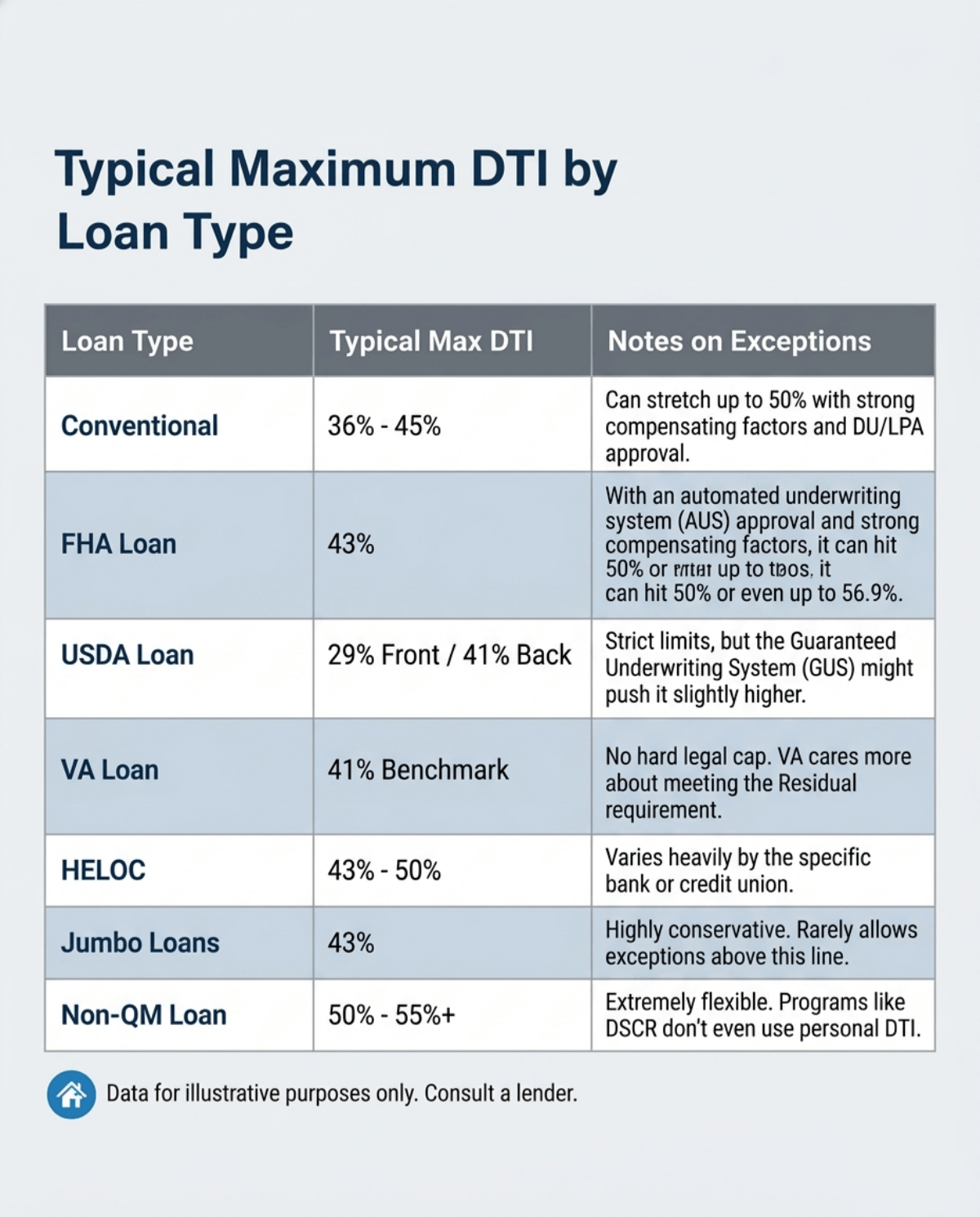
Every mortgage program has different tolerances for debt. Government-backed loans usually offer more flexibility compared to standard conventional products. Here is a quick look at the typical maximum DIT limits for the US market:

  • Conventional Loan: 45% - 50% (with strong automated approval)
  • FHA Loan: 43% - 50%+ (with compensating factors)
  • VA Loan: No hard cap. 41% guideline (flexible with strong residual income and compensating factors).
  • USDA Loan: 41% - 44% (with waiver/compensating factors)
Max DTI Requirements by Loan Types

Pro Tip: Mortgage guidelines frequently update based on market conditions. To ensure your max DTI perfectly aligns with the latest lender overlays, loan officers and mortgage professionals can quickly verify current guidelines using Zeitro Strata. It's an internal tool I highly recommend for staying perfectly compliant.

Why Does Mortgage Debt-to-Income Ratio Matter?

From a risk management perspective, a high debt load directly correlates with a higher risk of default. If you lose your job or face an emergency, heavily indebted borrowers are historically the first to miss payments. That is why this metric is deeply woven into the underwriting process.

Here is exactly how it dictates your homebuying journey:

  • Loan Approval: It is the ultimate gatekeeper. If your percentage exceeds the program's cap, your application will be denied, regardless of a flawless credit history.
  • Interest Rates: Lower ratios signal lower risk, allowing lenders to reward you with cheaper interest rates and better terms.
  • Loan Options: Keeping your debts minimal opens up the entire market. You won't be restricted to specific high-cost government programs and can freely choose the product that best fits your long-term wealth strategy.

How Does DTI Affect Mortgage Affordability?

Beyond simple approval, your debt profile directly controls your actual purchasing power. It literally dictates how expensive of a house you can buy.

I often see high-earning professionals get frustrated because they cannot get approved for their dream home. They might make $15,000 a month, but if they have massive student loans and two luxury car leases eating up $4,000 monthly, their "effective budget" is severely compressed. The bank will strictly cap the new housing payment to ensure the total back-end ratio stays within limits.

Simply put, for every extra dollar you owe in recurring consumer debt, your maximum allowable mortgage payment shrinks. Controlling your outside liabilities is the fastest way to increase how much house you can afford.

How to Lower Mortgage Debt-to-Income Ratio?

If your math came out higher than expected, don't panic. You can actively improve your financial profile before applying. Here are the most effective strategies I advise my clients to implement:

  • Pay off existing debt: Target small balances or high monthly payment loans first. Eliminating a $300 car payment drastically improves your ratio.
  • Increase your gross income: Ask for a raise, pick up a side hustle, or document your freelance income. A higher denominator instantly lowers the percentage.
  • Avoid taking on new credit: This is crucial. Never finance a new car, buy furniture on credit, or open new credit cards in the months leading up to a home purchase.
  • Consider a co-signer: Adding a non-occupant co-borrower with strong income and zero debt can significantly dilute a high DTI.

FAQs About Mortgage DTI

Q1. What is included in debt-to-income ratio?

Your calculation includes the projected mortgage payment, credit card minimums, auto loans, student loans, personal loans, and mandatory child support. However, everyday living expenses like groceries, utility bills, cell phone plans, and health insurance are completely excluded from this formula.

Q2. What is a good debt-to-income ratio for a mortgage?

A good DTI is 36% or lower. Keeping your total debt beneath this threshold signals excellent financial stability to underwriters. It easily helps you secure the absolute best interest rates, requires fewer compensating factors, and grants you the widest variety of loan program choices.

Q3. What is the 28-36 rule for mortgages?

The 28-36 rule is a standard financial guideline used by lenders. It dictates that a household should spend a maximum of 28% of its gross monthly income on total housing expenses, and no more than 36% on all total combined debt obligations.

Q4. How much debt-to-income ratio can you have to buy a house?

Depending on the specific loan type, you can typically have a maximum ratio between 43% and 50%. While conventional loans prefer lower numbers, government-backed options like FHA and VA loans are far more forgiving, occasionally allowing limits to stretch past 50% with strong credit.

Q5. Is rent included in the debt-to-income ratio for mortgage?

If you are buying a primary residence, your current rent is not included because the new mortgage will replace it. However, if you plan to keep your current rental apartment while buying an investment property, that monthly rent will absolutely be factored into your total liabilities.

Conclusion

Wrapping things up, your mortgage debt-to-income ratio is the undisputed foundation of your loan approval process. While credit scores get all the hype, your DTI proves to the bank that you can actually afford the monthly payments. Ideally, keeping your total obligations under 36% will ensure the smoothest transaction and the best rates possible.

I strongly encourage you to review your debts several months before ever submitting a loan application. Pay down those high-balance credit cards and avoid taking out any new loans. If you are unsure where you stand, use an online calculator to run your numbers today. And for my fellow mortgage professionals working on tricky files, don't forget to leverage tools like Zeitro Strata to cross-check those ever-changing maximum guidelines!

People Also Read

Try Zeitro today and transform your loan origination workflow!

Get started free